|
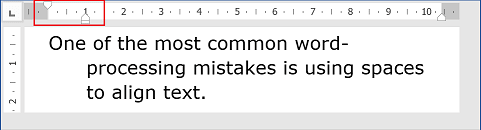
Professionally printed material in English typically does not indent the first paragraph, but indents those that follow. So, a negative indent or hanging indent is used, as an indent that indents all text except the first line:
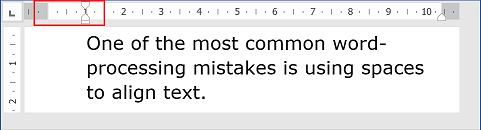
The hanging indents used in Bibliographies, References pages, and sometimes in scripts, dictionary entries, and footnotes. Another common modern English style is the lack of indentation, and the addition of vertical white space to create "block paragraphs":
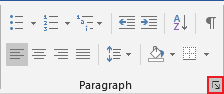
The block paragraphs commonly used for block quotations. Customize the paragraph format1. Click the paragraph you want to format or select multiple paragraphs. 2. Do one of the following: On the Home tab, in the Paragraph group, click the dialog box launcher:
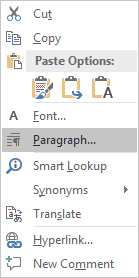
Choose Paragraph... from the shortcut menu (right-click or press Shift+F10), to display the Paragraph dialog box:
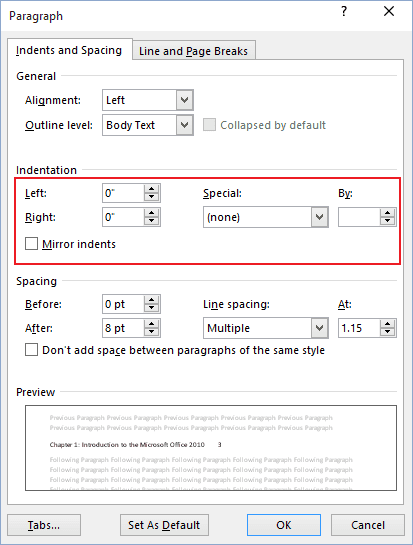
3. In the Paragraph dialog box, choose or type the appropriate values for Left, Right or Special (First line or Hanging) indents:
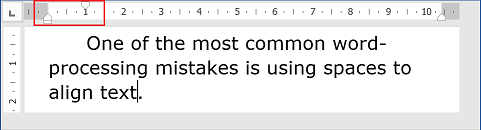
To do so, click in the paragraph you want to format or select multiple paragraphs, and then drag the First Line Indent marker left or right to the desired location. Use shortcutsYou can press Ctrl+T to create a hanging indent that aligns body text with the first tab marker. (By default, tabs are set every 0.5 inch.) You can press Ctrl+Shift+T to "unhang" an indent, regardless of how the hanging indent was created. Press Ctrl+Shift+M to decrease a paragraph's indent by one tab stop. By default, tab stops are set every 0.5 inch. Press Ctrl+M to increase a paragraph's indent by one tab stop. By default, tab stops are set every 0.5 inch. You can instantly add a full line space before a paragraph by selecting the paragraph(s) you want to format and pressing Ctrl+0 (zero). If you select multiple paragraphs, pressing Ctrl+0 adds a blank line space before each paragraph in the selection. See also this tip in French: Comment créer un retrait négatif de première ligne. (责任编辑:) |